De Administratie: from data silos to scalable client advisory
How De Administratie centralised data with Datalab, reduced error margins and laid the foundation for dashboards, benchmarking and data-driven client advisory.
24 June 2026
4 min read
De Administratie is an accountancy firm that has used technology from the start to work more intelligently. The goal is not only to administer more efficiently, but to create room for tailored advice. Looking back remains important, but entrepreneurs especially need insights that help them look ahead.
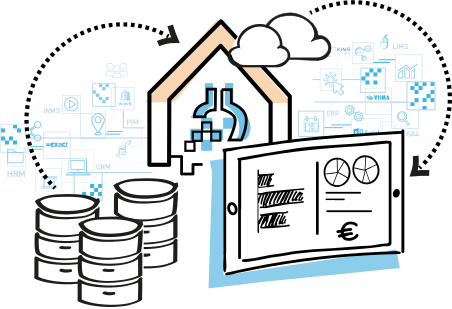
To make that possible, data from many separate systems had to come together. Like many firms, De Administratie worked with financial administrations, payroll data, CRM information and practice applications that each held their own version of the truth. As long as that data remains scattered, every advisory report requires extra work and error margins remain difficult to spot.
The challenge: plenty of valuable data, but spread across silos
Administration and accountancy firms have access to an exceptional amount of client data. Financial data may sit in Exact or Visma, payroll information in systems such as Nmbrs, and client contact in CRM solutions such as Zoho, TribeCRM or Salesforce. Alongside that there are practice applications, exports, audit files and custom files.
For De Administratie, the question was: how can we use those sources without teams continuing to copy, check and interpret data manually? Combining data is valuable, but also vulnerable. Different definitions, incomplete exports and contradictory figures can lead to the wrong conclusions.
"To give our services extra value, we had long been thinking about connecting the different pieces of data so we could advise even better. The many different software programs prefer to keep all that data to themselves."
Raymond van Lier, managing director and co-founder of De Administratie
The approach: start with a sharp Quick Scan
Datalab began with an inventory of the available data flows. Which sources are present? Which data is reliable enough? Which definitions differ by system? And where would connecting data create immediate value for internal processes or client advisory?
That Quick Scan worked like an X-ray of the data landscape. It showed not only the technical possibilities, but also the places where error margins could be reduced. This created a concrete starting point: not an abstract data programme, but targeted next steps based on what the firm already had in place.
"During the inventory phase, not only did the efficiency improvements become visible, it also turned out we could reduce our error margins."
- Raymond
The solution: data warehouse, dashboards and reusable extracts
Based on the inventory, a data foundation was designed in which sources come together safely and repeatably. A cloud data warehouse forms the basis. On top of that, dashboards, checks and data extraction tooling can be set up.
That is important for De Administratie itself, but also for the firm's clients. When data models and definitions are reusable, a dashboard does not have to be rebuilt from scratch each time. Client advisory becomes scalable, while the content becomes sharper and more personal.
The first applications focus on:
central access to client and administration data;
dashboards for insight into performance, deviations and trends;
benchmarking between comparable administrations;
data extracts that clients can use directly;
a foundation for further automation, forecasting and AI applications.
The result: staying more relevant for the client
De Administratie wants to remain relevant in a sector where much administrative work is becoming increasingly automated. Data helps strengthen the role of controller and adviser: not only reporting what happened, but explaining what is happening and looking ahead to what is likely to come.
With dashboards, a data warehouse, data extraction tooling and onward delivery to clients, the first steps have been taken. The foundation makes it possible to compare administrations, identify deviations faster and support advisory conversations with better evidence.
BPO and De Administratie: advisory strength on top of the data foundation
The accountancy case is part of the broader collaboration between Datalab, BPO and De Administratie. Datalab provides the data foundation and technical coherence, while BPO adds the controller perspective: interpreting figures, looking ahead and helping entrepreneurs steer.
That combination is what makes data valuable. A dashboard only matters when it leads to better choices, sharper signals and an advisory conversation that goes beyond the annual accounts.
What other firms can learn from this
The main lesson is that data-driven working does not have to start with a large platform programme. A strong first step is often a sharp inventory: which sources are available, which questions matter to partners and clients, and where does manual work currently take the most time?
From there, a firm can grow modularly. First a data model, dashboard or signal. Then more sources, more clients, continuous auditing or AI support.