Multiethnic group of designers and architects working in an office
For municipalities, public organisations and non-profits

Reliable policy information for public organisations

Datalab helps public organisations bring together data from policy, delivery and finance. We build dashboards and data platforms with which teams track developments and substantiate accountability. Definitions, access and management are set up to your organisation's requirements. The foundation underneath: Datalab Society Studio, for municipalities, knowledge institutes and other public organisations.

What is Datalab Society Studio?

A complete data solution for public and social-purpose organisations where reliability, explainability and continuity matter more than quick standalone dashboards.

Datalab Society Studio

A data platform for regulated and social-purpose environments

Datalab Society Studio is a data platform with source unlocking, data models, permissions, a data catalogue, dashboards, analytics and, where appropriate, AI. It is suitable for municipalities, provinces, public bodies, non-profits, knowledge institutes and health-care-related organisations.

We explicitly design for robustness, data security, data sovereignty, traceability and alignment with policy. The result is not only technology, but a governable environment in which leadership, policy, operations and information management can responsibly use the same figures.

Datalab can deliver individual parts, such as a data catalogue, dashboard environment or source unlocking, but can also realise the full platform. Because we are also experts in data governance, we carefully embed the solution in existing policy frameworks, decision-making and management processes.

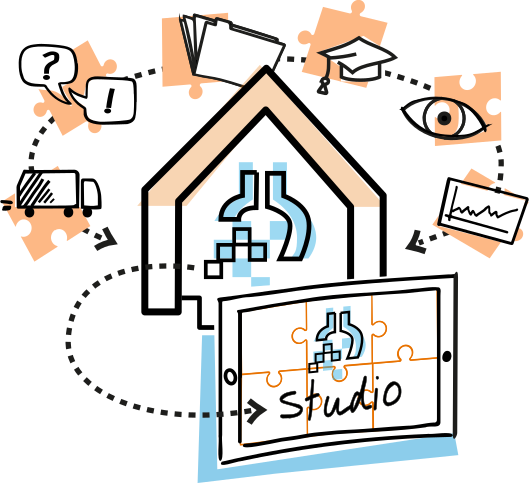
Platform

Robust data platform foundation

A scalable environment where policy data, financial data, operational data, public sources and custom files come together securely.

Sources

Source unlocking and data catalogue

We unlock sources in a controlled way, record provenance and make datasets findable and understandable for the teams that use them.

Use

Dashboarding, analytics and AI

From policy dashboards and accountability reporting to R Shiny, Power BI, forecasting or controlled AI applications.

Governance

Embedded in policy and management

Definitions, ownership, permissions, quality checks, logging and management agreements become part of the implementation.

Applications

Three applications with a clear result

Examples of applications we can set up for public organisations - intended as an illustration of what is possible. Which application fits your organisation is something we determine together. Municipalities, knowledge institutes, health-care-related organisations and non-profits each bring their own questions.

1 Policy & budget

Are delivery and budget on track?

A policy dashboard puts budget and actuals next to the chosen indicators, with explanations of variances. For municipalities this may involve the social domain, spatial development or safety; for non-profits it may involve impact, projects and accountability to funders.

Definitions and provenance remain recorded and explainable, so leadership, policy and delivery use the same figures - including at the moment of accountability.

2 Public services

Where do public services get stuck?

An overview of lead times and workload per process step shows where applications are left waiting and where capacity is strained. With a reference date and agreed definitions, so the figures are usable in the conversation between delivery and management.

3 Projects

Which projects and programmes need steering?

Project progress, available resources and reporting moments in one overview - for example for subsidy programmes or investment agendas. This makes it visible earlier which project needs attention, rather than only afterwards in the report.

Client cases

Public data in practice

Each case shows a different part of our services. Clingendael is a realised data and dashboard solution: complex source unlocking with granular access control. NMVO is an advisory assignment: carefully formulating and testing requirements before a software and supplier choice. For the municipalities, the role differs per assignment: platform, pilot or advice.

Municipality of Weert

Production environment: complete platform for complex data analysis and advanced dashboards.

Municipality of Roermond

Pilot: environment for gaining experience with data-driven working, led by Datalab.

Municipality of Nijmegen

Advice: modernising and setting up a sovereign data platform.

Collaboration

Three ways to use Datalab Society Studio

Datalab delivers what fits your capacity. Organisations without their own data team have Datalab build and manage the complete result; organisations with their own information or BI team choose co-building or just the foundation.

Optie #1

Complete programme

Datalab guides the full process: selecting use cases, setting up governance, unlocking sources, building dashboards, taking users along and developing further. You assess goals, definitions and results.

  • Also suitable without your own data team
  • From exploration to management and further development
Optie #2

Build together

We build the foundation and first applications together with policy, information management, operations and key users. You provide source knowledge and users; knowledge grows inside your organisation while results emerge.

  • Practical for municipalities and public bodies
  • Governance and adoption grow with the solution
Optie #3

Foundation for your own team

Datalab delivers the platform, connectors, data models, permissions and quality checks, with documentation and handover. Your own information, data or BI team further develops dashboards and analyses.

  • For organisations with their own data capacity
  • Clear architecture, handover and management agreements
Open source

Open tooling as a substantiated design choice

Datalab uses open source tooling where it is a substantiated design choice. Open source is not in itself a guarantee of security, compliance or lower cost - it does make it verifiable how the solution works and reduces dependence on a single supplier. That is why, for each programme, we make explicit how dependence, management and transferability are arranged.

Transparent and controllable

Components, data models and ways of working can be assessed, transferred and documented.

Modular to build

Start small with a dashboard, data catalogue or platform component and expand without starting again.

Less vendor lock-in

Open standards and portable architecture keep future choices open.

How do we start?

From public data question to a manageable platform with clear governance and a route that fits your organisation.

1.

Choose public value and policy context

We choose a sharp first question: policy steering, accountability, operations, data security or cost control. Policy, GDPR, information security and decision-making are included from the start.

Resultaat: a clear scope with administrative context.

2.

Define governance and ownership

We determine definitions, data sources, data owners, access rights, quality checks and accountability lines. This prevents governance from having to be repaired afterwards.

Resultaat: agreements about data that are workable and explainable.

3.

Choose platform and deployment route

We choose the right technical route: Dutch or European cloud, on-premises, hybrid or conventional cloud with a migration path. We consider robustness, management, cost and sovereignty.

Resultaat: a feasible architecture without vendor interest.

4.

Develop the platform and first data products

We unlock the first sources, set up the platform and build the first data products: dashboards, analyses, reports or applications that deliver immediate value. After that, management, adoption and expansion follow in the division of roles that suits your organisation.

Resultaat: a working foundation with visible applications.

Frequently asked questions

Questions about data for public organisations

Practical answers about public data, governance, sovereignty, cost and collaboration.

Is Datalab Society Studio only for municipalities?

No. The solution is intended for municipalities, provinces, public bodies, knowledge institutes, health-care-related organisations and non-profits. The common denominator is that data must be reliable, explainable, secure and manageable.

What is the difference between dashboards, predictive models and AI?

A dashboard visualises what has happened or is happening now, based on recorded definitions. A predictive model calculates an expectation, for example of workload or capacity, with an explicit method and margin of error. AI performs a specific task, such as summarising text or flagging anomalies, always with human review. For each application we state which form is used, so the offer remains verifiable.

Which services and consultancy pages connect to this?

Datalab Society Studio is the complete solution route for public organisations: from governance and platform to adoption. For defined parts, our services connect to it: Data strategy & consulting for governance, roadmap and choices, Dashboards & BI for dashboarding, Data warehouse setup for the data foundation and the Sovereign Cloud Dataplatform for sovereign platform choices. Consultancy is different: it adds temporary specialist capacity alongside your team, for example a data strategy consultant, Power BI consultant for dashboarding or DBT and data modelling consultancy for the data model.

Can you also implement locally, on-premises or sovereign?

Yes. Datalab Society Studio can run in Dutch or European cloud, on-premises, hybrid or in a conventional cloud environment with a migration path. You stay in control of data, access and future portability. Also read our page about the Sovereign Cloud Dataplatform.

Where does data governance appear in the programme?

From the start. We define definitions, source owners, ownership, access rights, quality checks, logging and management agreements before dashboards or analyses are rolled out broadly. Governance is not an appendix afterwards, but part of the implementation.

Is this feasible for small public organisations or non-profits?

Yes. We can start compactly with one data question, one dashboard, a data catalogue or a limited platform setup and then expand modularly. This keeps the first step manageable, even without a large data team.

What does Datalab Society Studio cost?

We can start small and expand from there. Datalab works with a fixed amount that includes connectors, platform, dashboards and management; licences (such as Power BI) and consumption costs are separate. In a no-obligation conversation we discuss what fits your situation and budget.

Do you offer discounts for charities?

Yes. For recognised charities and non-profit organisations with limited resources, we offer discounts. We align the discount with the purpose, scale and available capacity, so valuable social-purpose data projects do not fail because of a high entry threshold.

Do you also use AI or advanced analytics for public data?

Only when the foundation is right. We first look at data, permissions, traceability, model use and risks. Forecasting, R Shiny, Power BI, Python/R analyses or controlled AI applications can then be set up responsibly - each application with human review and a named limitation. Also see our ethical framework.

Discover what reliable policy information can do for your organisation

Bring an existing report, an indicator or a decision for which you currently lack information. In a no-obligation conversation we scope the first application and determine which sources and preconditions it needs.

Discuss your information question