Exports are not a reporting foundation
Manual files make recurring reports fragile and hard to control.
Make Lightspeed data centrally available for reports, dashboards and analysis. Datalab sets up a fixed data flow so this source becomes part of your reliable data platform.

When Lightspeed data is needed repeatedly, a fixed data flow helps keep reporting reproducible, current and manageable.
Lightspeed is used for point-of-sale processes, sales, stock and retail or hospitality reporting. Its data is highly operational: transactions, products, locations, customers and stock movements come together there. In a data warehouse, you can combine this source with finance, operations, commerce, customer data or other systems, while keeping definitions and history centrally available.
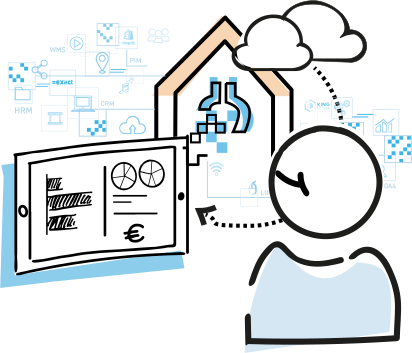
Manual files make recurring reports fragile and hard to control.
Source data becomes more valuable when it sits alongside other systems.
Monitoring, logging and error handling belong in a structural data flow.
We set up a controlled data flow from Lightspeed to your data warehouse. We start with the reports, KPIs and datasets you need repeatedly.
The connection can plug into an existing data warehouse or become part of a new data platform, so monitoring, documentation and future extension remain manageable.
We start with the datasets, KPIs and reports you need on a recurring basis.
We design authentication, extraction, loading logic and error handling for your Lightspeed environment.
The data becomes centrally, historically and controllably available in your data warehouse.
We model the data for e-commerce, retail and marketplace reporting, dashboards and combinations with other sources.
Lightspeed data helps strengthen recurring reporting and analysis around commerce and order reporting.
Lightspeed data can be part of broader data projects. That is why we show all solution areas in which data sources often come together.
We can make Lightspeed data available when it is reachable through your environment, permissions and technical access. This may include orders, products, customers, channels, stock, returns and payments. Custom data can also become part of the same data flow.
Yes. Once the data is centrally available, Lightspeed data can be combined with other relevant sources in the same data warehouse.
Yes. We can connect to an existing data warehouse or help set up a new data platform.
That depends on the complexity of your Lightspeed setup, the available access, the number of datasets and what you want to do with the data in reports or dashboards. It does not have to be a large project: we can often start compactly with the most important datasets and then expand in a focused way.
The aim is to replace recurring exports as much as possible with a fixed, controlled data flow from Lightspeed. For occasional checks an export can still be useful, but no longer as the basis for structural reporting.
Almost all common BI and reporting tools can connect to the unlocked Lightspeed data, including Power BI, Tableau, Excel and other tools that can connect to your data warehouse. We structure the data so users are no longer dependent on loose files.
Schedule a call. We will look at which Lightspeed data you need and which technical route fits your data platform.
Schedule a call